All About Oracles from the Team Securing Billions

When you're responsible for securing billions in on-chain assets, every millisecond matters. Every data point needs cryptographic proof. Every attack vector must be eliminated.
It's an impossibly hard problem.
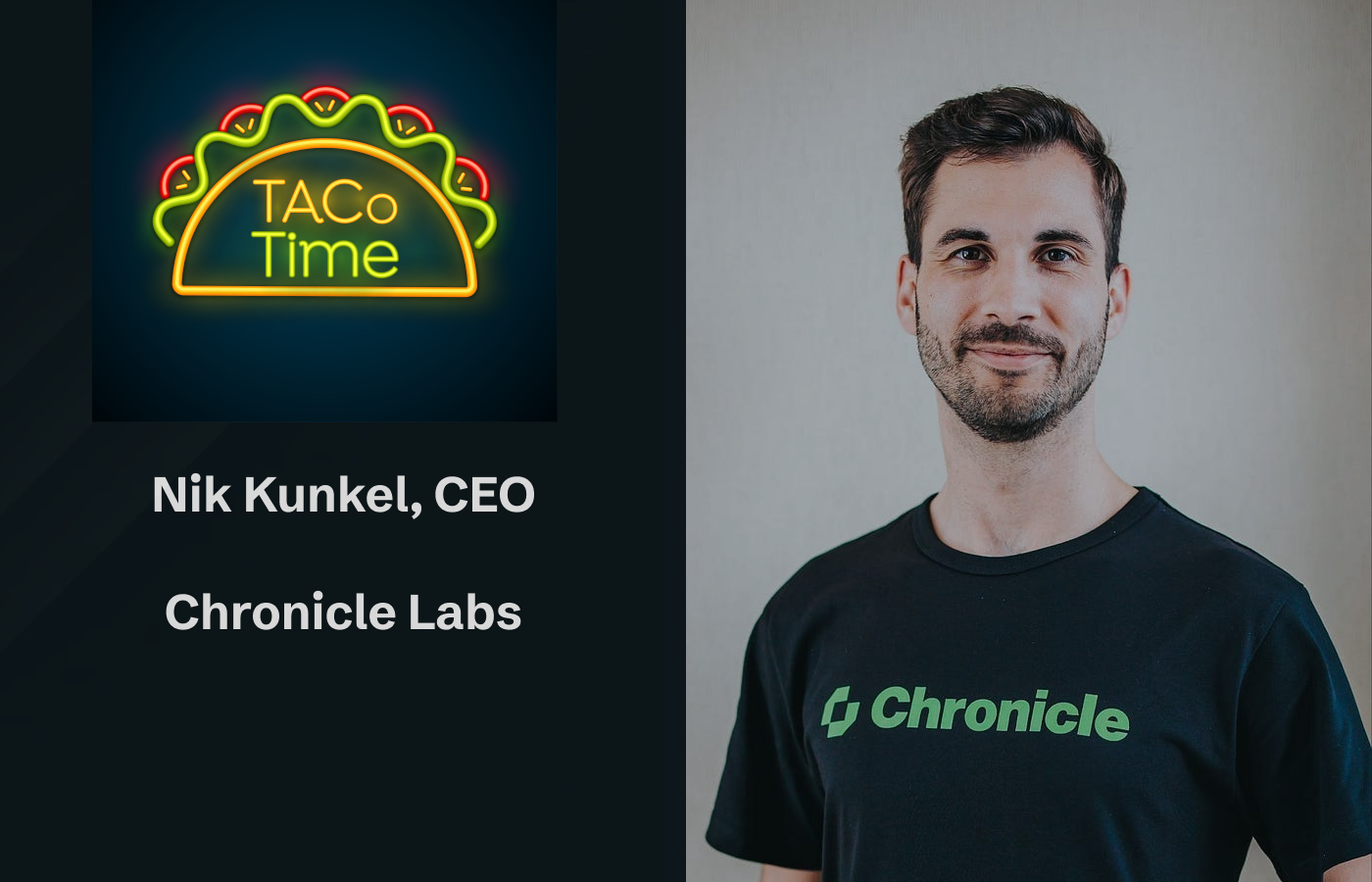
Niklas Kunkel learned this firsthand at MakerDAO, where his team built Ethereum's first oracles in 2017. Six years later, Chronicle, the company he founded, secures billions of dollars in tokenized asset allocations for Sky (formerly MakerDAO) and Grove.
The Oracle Problem: Blockchain's Achilles Heel
Think of blockchains as black boxes with complete omnipotence over internal data like wallet balances, timestamps, transaction history. But the moment an application needs external data like asset prices or treasury holdings, it hits a wall. "Put your phone on airplane mode," Niklas explains. "All of a sudden your applications can't send and receive data, and their utility becomes crippled."
This is the fundamental problem oracles solve: they're the bridge between blockchain applications and off-chain data. For tokenized assets, this means providing context about reserve collateral and other key data points that DeFi applications desperately need. When BlackRock's BUIDL token appears on-chain, applications see just a "thin wrapper." The oracle adds back the underlying reserves, yield calculations, maturity dates, and risk-adjusted metrics that enable proper integration.
From Weekend Builds to Billion-Dollar Infrastructure
The path to today's sophisticated oracle networks wasn't planned. At early MakerDAO, when the team needed funding, someone suggested: "What if we built a DEX to sell our tokens?" By the weekend, they had Ethereum's first DEX. Not because they wanted to revolutionize trading, but because they needed to pay salaries every six to eight weeks.
Building in those early days meant discovering that smart contracts didn't work by yolo deploying on-chain and seeing "out of gas" errors. No debuggers existed. Zero infrastructure. When Maker needed price feeds for their ETH and BTC-backed stablecoin, Niklas and Mariano Conti invented oracles on Ethereum from scratch, building the very infrastructure that would later secure billions.
How Oracles Work Today: Validator Consensus at Scale
Chronicle's current architecture relies on distributed consensus from trusted validators: entities like Etherscan, Infura, Gitcoin, and Bitcoin Suisse. When two-thirds agree on data accuracy, the oracle updates. This model secured Sky's billion-dollar "Grand Prix" allocations across BlackRock's BUIDL, SuperState's USTB, and Centrifuge's tokenized treasuries products.
But validator consensus comes with trade-offs. More validators mean higher security but increased latency. Five validators might achieve 30-millisecond updates, but they're vulnerable to collusion. More validators improve security but slow the system when real-time price changes need millisecond responses.
The Future: Zero-Knowledge Truth
The breakthrough coming in 2025 changes everything. Chronicle is implementing ZKTLS (Zero-Knowledge Transport Layer Security) proofs. Basically cryptography that proves data hasn't been tampered with during transmission. Instead of trusting validators not to manipulate data, the system provides mathematical proof that data came directly from sources like BNY Mellon's custody accounts.
"The ability for validators to manipulate data goes away," Nik explains. "You've made the system a whole order of magnitude safer." Validators still ensure uptime and availability, but they can't corrupt the data feed. Effectively removing a critical attack vector.
This isn't theoretical. Chronicle runs ZKTLS proof generation in parallel with their current validator system, testing at production scale while maintaining billion-dollar security standards. The technology needs more optimization—ZK proofs currently require powerful hardware and can take 20 seconds to generate, too slow for real-time price feeds. But the trajectory is clear.
Real-World Impact: From Mzero to Grove
The infrastructure is already enabling next-generation protocols. Mzero, built by ex-Maker founders Greg DePrisco and Luca Prosperi, integrates Chronicle's oracle so deeply that no stablecoin can be minted without express oracle approval. When someone requests to mint stablecoins, Chronicle physically checks their custodian accounts and issues a proof. No reserves verification, no minting.
Grove, Sky's billion-dollar allocation arm, uses Chronicle's data for automated rebalancing. If Treasury yields change or a custodian fails to report holdings, positions are adjusted.
The Trillion-Dollar Reshuffling
A reminder about how early we are. Today's onchain tokenized assets represent roughly $25 billion, excluding stablecoins while global assets are denominated in hundreds of trillions. We're witnessing the earliest stages of a fundamental migration onchain.
"I think there's going to be a bit of a race condition to release first, to scale these products before competitors can even release them," Niklas predicts. "There's going to be a big reshuffling of who the big players are in a digital financial world."
The infrastructure layer powering this migration isn't flashy. Oracle networks don't generate headlines like new Layer 1s or memecoin pumps. But they're the critical foundation enabling trillion-dollar asset digitization.