
Issuing a Bond Just Got 98% Cheaper and Months Faster

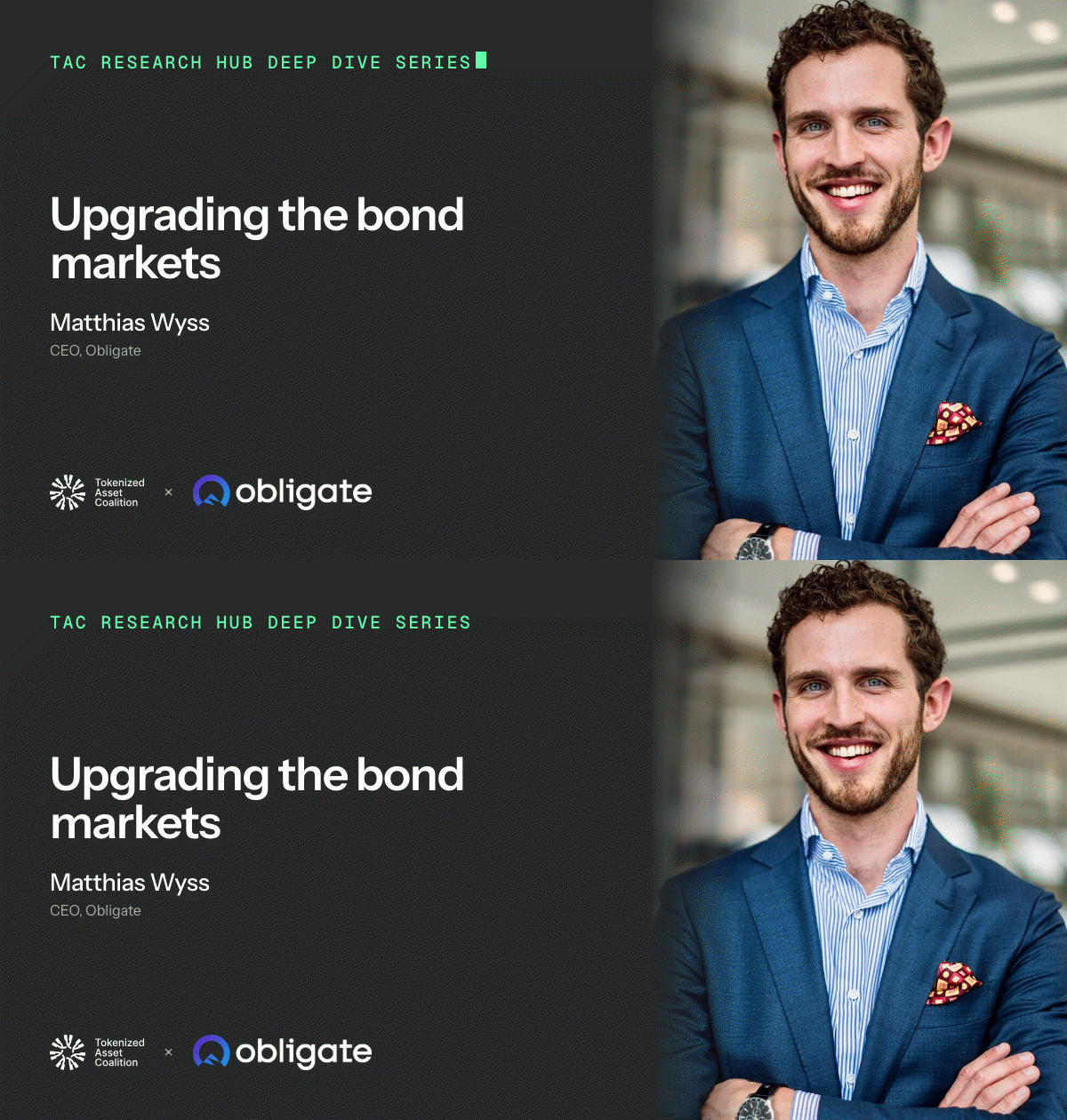
The oldest instrument in capital markets, the plain corporate bond, has barely changed in decades (centuries?). Issuing one still costs at least half a million dollars in fees, takes roughly six months, and only pencils out if you are raising $100 million or more. That math hands the tool to maybe the top 1% of companies on earth and locks everyone else out.
Obligate rebuilt the thing from scratch. This week its CEO Matthias Wyss walked me through six years of patient infrastructure work that is finally compounding into a product that might make DeFi-composable institutional credit real. Three ideas anchored the conversation: digitally native beats wrapped every single time, the boring legal work is the actual moat, and the bottleneck was never the technology.
The Number That Should Not Be Possible
A traditional public bond costs at least $500K, takes about six months, and only makes economic sense above $100 million in size. Obligate brings that to roughly $10,000 and a few weeks for a first issuance. A follow-on issuance on an existing program is minutes, because you are just deploying another smart contract, and the marginal cost is a few cents in gas. Minimum deal size is $1 million. For structured investment products, the floor drops to $100.
The foundation that makes this legal rather than clever is Swiss law, which Matthias told me they picked after reviewing 30 jurisdictions. Swiss law has had a framework for blockchain-based securities, called ledger-based securities, for five years. These are not derivatives of a bond or synthetic wrappers around one. They are legally identical to a physical paper bond, issued natively onchain. Obligate calls its version an E-Note, with the full lifecycle, issuance, coupons, redemptions, run by smart contract and the legal documentation stored as an immutable file linked to it.
The part worth underlining: as long as Ethereum is a decentralized network, these securities exist without Obligate needing to be in the loop. If you can interact with an ERC-20, you can claim a coupon. That is what digitally native actually means, and it is the direction this whole industry should be heading.
The Short Version of How Matthias Got Here
Matthias started on a London trading floor 15 years ago working structured products and derivatives, with an engineering background out of Switzerland. He went back to school at Oxford for an MBA, and in 2014 first ran into Bitcoin watching a debate between Mike Novogratz and the Winklevoss brothers pitching their ETF. He wrote his thesis on Bitcoin options and started a startup with a friend named Jonathan Levin. It was too early. Levin went on to found Chainalysis, and Matthias went into fintech, building quant software for private banks like UBS, Julius Baer, and LGT, scaling that business from 25 to 80 people and to roughly $20 million ARR.
His first full leap into Web3 was running a metaverse venture after an ICO, which he cheerfully calls his "executive MBA in running a Web3 venture." Figuring out Swiss VAT treatment on NFT sales in real time will do that. That work turned into a venture builder role, where he met Benedict and Stefan, the co-founders of Obligate. He took over as CEO in early 2024. The through-line is obvious once you hear it: capital markets, financial technology, and blockchain rails converging into one product.
The Mid-Market Was Where the Money Was Hiding
The original thesis was SME lending. What Obligate learned is that companies in the $100K to $1 million range need flexibility more than they need capital markets access, and smart contracts are the opposite of flexible. Matthias described early borrowers calling a week before repayment asking for a one-month extension. The answer was no. Repay one second late and you are in default. As he put it, the smart contract does not care.
That friction pushed them up-market into what he calls the sweet spot: companies with around $100 million in revenue and a $5 to $50 million debt capacity, too big for a small business bank loan and too small for wholesale capital markets. Names like Keyrock and Bitcoin Suisse sit in the portfolio. More interesting is the niche financing non-bank lenders who refinance their own balance sheets through Obligate. Trade Flow Capital Management finances cargo shipments globally in $500K to $1 million tranches and now runs most of its debt needs through the platform, with more than 50 individual bonds originated.
Obligate keeps each issuer as a single, segregated credit risk rather than commingling exposures, with transparent data rooms and independent assessments from partners like Cicada and Particula. The logic is that if an investor can buy exposure in $100 increments and build their own portfolio, nobody needs to blend it for them. Matthias calls that vision ETF 3.0.
RWA 10: A 10% Yield You Can Borrow Against
The product launching now is RWA 10, the first eTracker, and the name is the yield target. It wraps Trade Flow Capital Management's trade finance bonds into an evergreen structure with weekly liquidity instead of three-month lockups. The mechanic is a ladder of twelve three-month bonds. Every week a slice matures, and that liquidity either funds redemptions or gets reinvested with new subscriptions.
The primary market is permissioned and fully KYC and AML checked, like minting USDC. The secondary market is permissionless, so once you hold the token you can send it to any wallet, also like USDC. It launches on Base and Solana simultaneously, with integrations into lending markets like Morpho so users can borrow against it. The asset is triple-B rated.
This is the real unlock. Most onchain products with genuine real-world yield have quarterly liquidity at best, which makes them painful to plug into lending protocols that expect atomic redemptions. RWA 10 is engineered to solve that exact mismatch. Matthias made an observation worth stealing: a DeFi vault curator accepting collateral and deploying deposits is functionally doing what a bank does, liquidity and term transformation. The infrastructure is new. The economic function is ancient.
Distribution Is the Hard Part, Always
I asked about distribution because I have lived it. In fact, every company targeting the middle market understands the pain of the friction Matthias described: private credit is harder to sell than public credit because the underwriting burden sits on the buyer, not a ratings committee.
Obligate's answer was to not become a bank with thousands of retail clients. Instead they plug into regulated partners who already have those clients. Sygnum Bank, the FINMA-regulated Swiss crypto bank with over $5 billion in AUM, is the headline example, with a subscription flow built directly into the Sygnum platform so clients never onboard twice. On the institutional direct side the sales cycles run 12 to 18 months for eight-figure tickets, but the relationships scale once they land. The secondary market is where the real distribution lives, because once RWA 10 exists in wallets, anyone in the world with a wallet can access it. That is only possible because the issuance is digitally native.
Swiss Law as a Global Rail
A fair question: you originate under Swiss law but your borrowers span 15 jurisdictions, from the US to Cayman to Hong Kong to Singapore. Does that break? Matthias drew an analogy I had not heard before. ISDA, the bilateral framework every major bank uses for derivatives, runs on English law, and nobody questions it. Everyone simply agreed the contract lives on English law and it travels the world. Obligate's ledger-based securities work the same way: Swiss law for origination, globally applicable in practice.
The distribution regulation then falls to wherever the platform sits, not to Obligate. Transferring a security in the secondary market is not a regulated activity in most jurisdictions below certain thresholds. Market-making is, so Obligate routes around it with smart-contract-based algorithmic arbitrage and third-party balance sheets rather than its own. This is the legal moat. It does not make for splashy press releases, but when a sophisticated allocator's legal team starts asking what claim they actually hold, the answer is already built into the structure.
The Bottleneck Was Never the Technology
The most honest thing Matthias said all episode: "Humans are sticky. They don't like change per se." His evidence was the FX market. When he started in London in 2011, swapping euros for Swiss francs cost about 1% at a bank. It still costs roughly 1% today, even though Wise and 360T can do it for basis points. People have other problems. They do not optimize for finance unless forced to.
The corollary is that adoption compounds slowly and then suddenly. Six years in, he says he is only now seeing the effect, and his honest estimate for broad adoption is another five to ten years. As he put it, we can fly to Mars but it still takes six months to issue a bond. The platform is built for self-custody and zero intermediaries, with optional regulated custody for those who want it.
He closed with a line from his grandfather that I am going to keep: don't burn bridges, you always meet twice in life. In a market this early and this interconnected, that might be the best operating advice there is.
Watch or listen to the full episode on Spotify.